Блог · Luca Pacioli

19/09/2026 15:23 Счетоводство
Luca Pacioli: The Father of Modern Accounting
1. Who He Was?
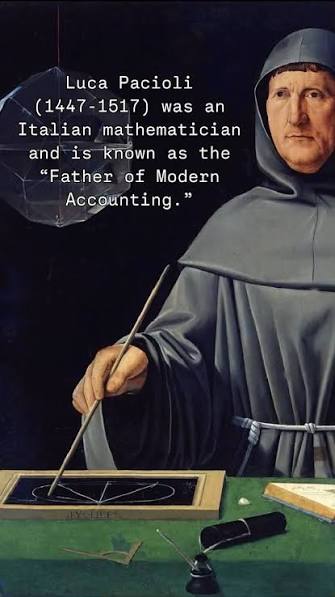
Fra Luca Bartolomeo de Pacioli was an Italian mathematician, Franciscan friar, and collaborator with Leonardo da Vinci, recognized as an early contributor to the field now known as accounting. He is referred to as the father of accounting and bookkeeping, being the first person to publish a work on the double-entry system of bookkeeping on the European continent.
Fra Luca Bartolomeo de Pacioli was an Italian mathematician, Franciscan friar, and collaborator with Leonardo da Vinci, recognized as an early contributor to the field now known as accounting. He is referred to as the father of accounting and bookkeeping, being the first person to publish a work on the double-entry system of bookkeeping on the European continent.
2. Origin
• Born around 1447 in Sansepolcro, in the Republic of Florence (Tuscany, Italy).
• He was also called "Luca di Borgo," after his birthplace, Borgo Sansepolcro.
• He received an abbaco education there — instruction in the vernacular language rather than Latin, focused on the practical knowledge required of merchants.
• Died on 19 June 1517, at roughly 69–70 years of age, in Sansepolcro.
3. His Profession and Vocation
• Occupations: Friar, mathematician, writer.
• As a young man he moved to Venice, one of the great trading centers of the era, where he assisted a merchant and absorbed the accounting methods used by Venetian traders.
• He later entered the Franciscan order, which gave him the institutional support to pursue his academic work, and taught mathematics at several Italian universities, including Perugia, Naples and Rome.
4. His Major Work and When He Wrote It?
• Title in the original: Summa de arithmetica, geometria, proportioni et proportionalita.
• First published in 1494, in Venice, by the publisher Paganini.
• A 615-page work in its first edition, written in vernacular Italian, considered the first printed work on algebra.
• It also contains the first published description of the double-entry bookkeeping system, within a specific section titled Particularis de Computis et Scripturis ("Particulars of Reckonings and Writings").
5. His Name in Latin and English
• Latin/original form: Luca Bartolomeo de Pacioli, also recorded as Paccioli or Paciolo.
• English form: Luca Pacioli.
• Title of his principal treatise in Latin usage: Particularis de Computis et Scripturis.
• English form: Luca Pacioli.
• Title of his principal treatise in Latin usage: Particularis de Computis et Scripturis.
6. The Venetian System of Double-Entry Bookkeeping
• Double-entry bookkeeping itself had been invented in the 13th century and was already used by Venetian merchants, but it was not yet widely known when Pacioli described it.
• The system he published included most of the accounting cycle essentially as it is known today.
• Double-entry bookkeeping had already been in use in Venice for around two hundred years before the publication of the Summa — Pacioli's contribution was to record and systematize it in print, not to invent it from nothing.
• The method rests on the principle that every transaction is recorded twice — once as a debit, once as a credit — so that the books remain permanently balanced, a discipline that still underlies every ledger, every financial statement, and every accounting system in use today.
7. Why He Laid the Foundations of Modern Accounting?
• His impact on the subsequent development and standardization of professional accounting methods was so significant that Pacioli is referred to as the "father of accounting".
• By putting the Venetian merchants' oral, practice-based tradition into a printed, structured, teachable form, he turned bookkeeping from a craft passed down informally into a codified discipline that could spread across Europe.
• His collaboration with Leonardo da Vinci and his standing as a scholar of his era — reflected in the fact that his portrait was painted in 1495, an honor reserved for notable figures — placed his work at the center of Renaissance intellectual life, giving it lasting authority.
Exquisite Ltd - Varna
www.exquisite.bg; office@exquisite.bg