Блог · Company Formation in Bulgaria

Company Formation in Bulgaria
The formation of a company (company creation) in Bulgaria is a procedure which may appear complex at first glance; however, it is in fact a fully manageable process, provided that one is familiar with the required steps, documentation, and statutory requirements. This guide outlines all types of companies that may be established in Bulgaria, the stages of registration, the required documentation, specific considerations regarding the choice of company name, share capital, partners or shareholders, as well as all banking procedures — from the capital-raising account to the operational current account.
1. Types of Companies in Bulgaria
In Bulgaria, the following legal forms may be registered:
1) ET – Sole Trader (Ednolichen Targovets)
Registration of a natural person carrying out commercial activity in their own name.
2) EOOD – Single-Member Limited Liability Company
The most commonly used legal form. One owner – minimum share capital: BGN 2.
3) OOD – Limited Liability Company
Two or more partners. A flexible and practical structure for small and medium-sized enterprises.
4) AD – Joint-Stock Company
Suitable for larger enterprises. Minimum share capital: BGN 50,000.
5) EAD – Single-Member Joint-Stock Company
A joint-stock company with one sole shareholder.
6) KD – Limited Partnership
Comprises a general partner (with unlimited liability) and a limited partner (with liability limited to their contribution).
7) SD – General Partnership
All partners bear unlimited and joint liability.
8) KDA – Partnership Limited by Shares
A less common hybrid form combining elements of a limited partnership and a joint-stock company.
9) Branch of a Foreign Company
Not a separate legal entity, but allows a foreign company to conduct business activities in Bulgaria.
10) Non-Profit Organization / Association / Foundation
Legal entities established for non-profit purposes.
2. Pre-Incorporation Requirements: Planning and Key Decisions
2.1. Choice of Company Name
• The name must be unique and not already registered in the Commercial Register.
• It must not contain misleading elements or protected terms (e.g., “Bulgaria”, “Europe”) without the required authorization.
• Availability may be verified online through the information system of the Commercial Register.
2.2. Scope of Business Activity
• A company may have an unlimited number of business activities.
• It is important to include all intended fields of activity.
• Registration under the National Classification of Economic Activities (NACE/KID) is also possible.
2.3. Share Capital
• For EOOD/OOD: minimum 1 €.
• For AD: minimum 25000 €.
• For ET: no statutory capital requirement.
2.4. Partners or Shareholders
• Personal details of all participants: full name, address, Personal Identification Number (EGN), Foreigner Identification Number (LNCh), or passport number.
• Allocation of shares or stock.
• Appointment of manager(s) or governing bodies.
3. Required Documentation
For EOOD/OOD:
• Articles of Incorporation or Memorandum of Association.
• Resolution/Minutes appointing a manager.
• Notarized specimen signature of the manager.
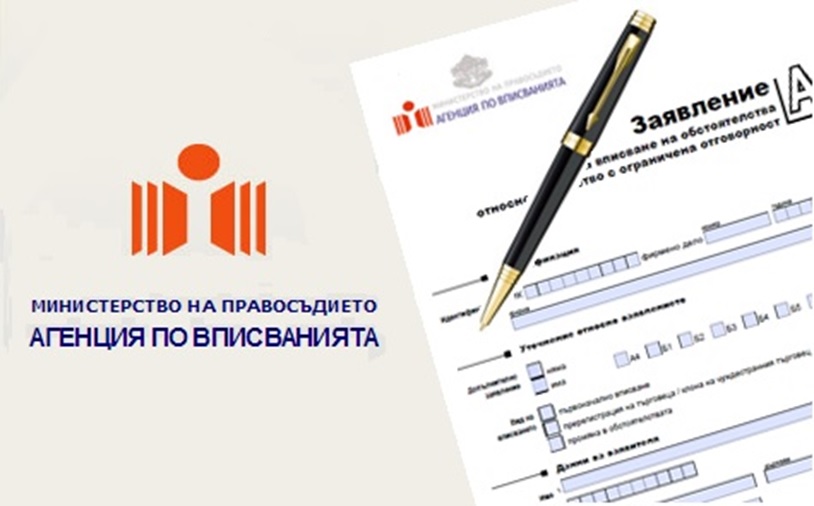
• Application for registration (Form A4).
• Declarations pursuant to Article 13, paragraphs 4 and 5 of the Commercial Act.
• Bank certificate confirming paid-in capital.
• Proof of payment of the state registration fee.
For ET:
• Application Form A1.
• Specimen signature.
• Declarations pursuant to the Commercial Act.
For AD/EAD:
• Articles of Incorporation.
• Statutes (By-laws).
• Notarial certifications.
• Bank certificate confirming paid-in capital.
• Full documentation regarding the governing bodies.
4. Registration Procedure – Step by Step
Stage 1: Preparation of Documents
All incorporation documents are prepared in advance — founding acts, declarations, resolutions, and related corporate documentation.
Stage 2: Opening and Depositing the Share Capital
• A capital-raising bank account is opened.
• The share capital is deposited.
• The bank issues a certificate confirming the deposited capital, which is attached to the application.
Stage 3: Notarial Certifications
The manager signs:
• Specimen signature
• Declarations (where required)
Stage 4: Filing with the Commercial Register
Documents are submitted either electronically or in person to the Registry Agency (Commercial Register).
• The state fee is lower when filing electronically.
• Registration period: usually 1–3 business days.
Stage 5: Issuance of UIC (Unified Identification Code)
Upon registration, the company acquires legal personality and is officially established as a legal entity.
Stage 6: Opening an Operational Bank Account
After registration, a standard current account is opened:
• In Euro (EUR)
• In foreign currency (if necessary)
The capital-raising account is subsequently closed, and the share capital is transferred automatically or upon instruction to the new operational account.
5. Post-Incorporation Registrations
• VAT registration (mandatory or voluntary).
• BULSTAT registration (for sole traders and self-employed professionals).
• Employment contracts and social security registration when hiring personnel.
• Cash register registration where required by law.
• Licenses and permits, where applicable.
6. Practical Advice When Establishing a Company
• Choose a concise and memorable company name.
• Prepare all documentation in advance to avoid delays.
• Select a bank offering competitive business account fees.
• Consider future VAT registration, especially when working with EU partners.
• Plan from the outset who will be responsible for the company’s accounting.
We from Exquisite Ltd – Varna provide assistance to prospective clients in establishing their own company through our trusted business partners. Following registration, we undertake full and professional accounting services for our clients.
www.exquisite.bg; office@exquisite.bg